

AI-Powered Coaching: Benefits, Essential Tools, and Future Trends

When we discuss AI in coaching, we refer to software that supports human coaches with automation, clearer data, and tailored interventions to enhance results. This piece demonstrates how AI enhances efficiency, expands access, and enhances personalization by integrating machine learning, natural language processing, and progress dashboards. You’ll get a practical look at the main benefits of AI-enhanced coaching, the categories of tools available, how humans and AI can work together day-to-day, important ethical guardrails, and concrete niche use cases for executive and employee development. Many organizations struggle with uneven coaching quality and limited coach capacity; thoughtfully adopted AI tools can automate routine work, surface objective insights, and deliver customized learning paths — while keeping humans in charge of judgment and empathy. Below, we map the landscape: benefits and mechanisms, tool categories and comparisons, hybrid collaboration models with governance checklists, ethical considerations and emerging tech, and niche applications with measurable outcomes. Along the way, we use search-friendly phrases like AI coaching effectiveness, AI coaching tools, NLP for coaching, and AI-powered analytics to help with practical adoption.
For all the coaches out there, I will also show you how I utilize these AI tools to enhance my own coaching business and share some simple things you can do to improve your coaching sessions.
What Are the Key Benefits of AI in Coaching?
AI adds measurable value by cutting administrative overhead, personalizing learning paths, generating data-driven insights, and expanding reach through scalable micro-coaching. Machine learning finds patterns in sessions and outcomes to suggest timely next steps, while natural language processing pulls sentiment and themes from conversations to reveal blind spots. Together, automation and analytics reduce time on noncoaching tasks and improve decision quality — which translates into higher goal attainment and better engagement. Grasping these core benefits sets the stage for the practical ways AI increases efficiency and personalization that follow.
AI-enhanced coaching delivers five core advantages that address common pain points:
- Administrative efficiency: Automations take care of scheduling, notes, and follow-ups so coaches focus on the work that matters.
- Personalization at scale: ML-driven learning paths adapt to progress and preference, improving adherence and outcomes.
- Data-driven insight: Analytics produce objective progress metrics and highlight behavioral trends that guide strategy.
- Scalability and access: Virtual assistants and micro-coaching increase frequency of contact beyond scheduled sessions.
- Consistency and quality control: Standardized analytics and processes raise the floor for coaching quality across cohorts.
Each benefit links to concrete mechanisms and measurable outcomes that organizations can track to assess AI coaching effectiveness.
Quick comparison of benefits, mechanisms, and outcomes:
This mapping makes it clear how each benefit emerges from a mechanism and produces measurable results — useful when leaders prioritize investments.
How Does AI Increase Coaching Efficiency and Automation?

AI boosts efficiency by handling routine tasks: meeting booking, transcript capture, summary creation, and follow-up nudges. These automations shrink administrative load and speed feedback loops. ML models convert raw transcripts into structured notes and action items, while calendar integrations take care of availability and bookings. The outcome: coaches spend less time on logistics and more on strategy and rapport — increasing capacity and improving the client experience. Practitioner reports show automation can recover a meaningful portion of a coach’s weekly admin hours, shifting focus toward higher-impact coaching.
Concrete examples: automatic session summaries that flag objectives, commitments, and next steps; follow-up reminder sequences that lift adherence; and CRM or LMS integrations that keep progress in sync. These features rely on pattern recognition — models spot recurring themes and action verbs and present clear, coach-ready outputs. That tighter feedback loop between session insight and client behavior is the foundation for the personalization techniques described next.
How I Use AI tools: As a business and real estate coach, I utilize tools to automatically send summaries to my clients, including action items or to-do’s for our next session. This allows them to have a plan and know what to work on next. This way, there is no confusion during our next session.
In What Ways Does AI Personalize Client Coaching Journeys?
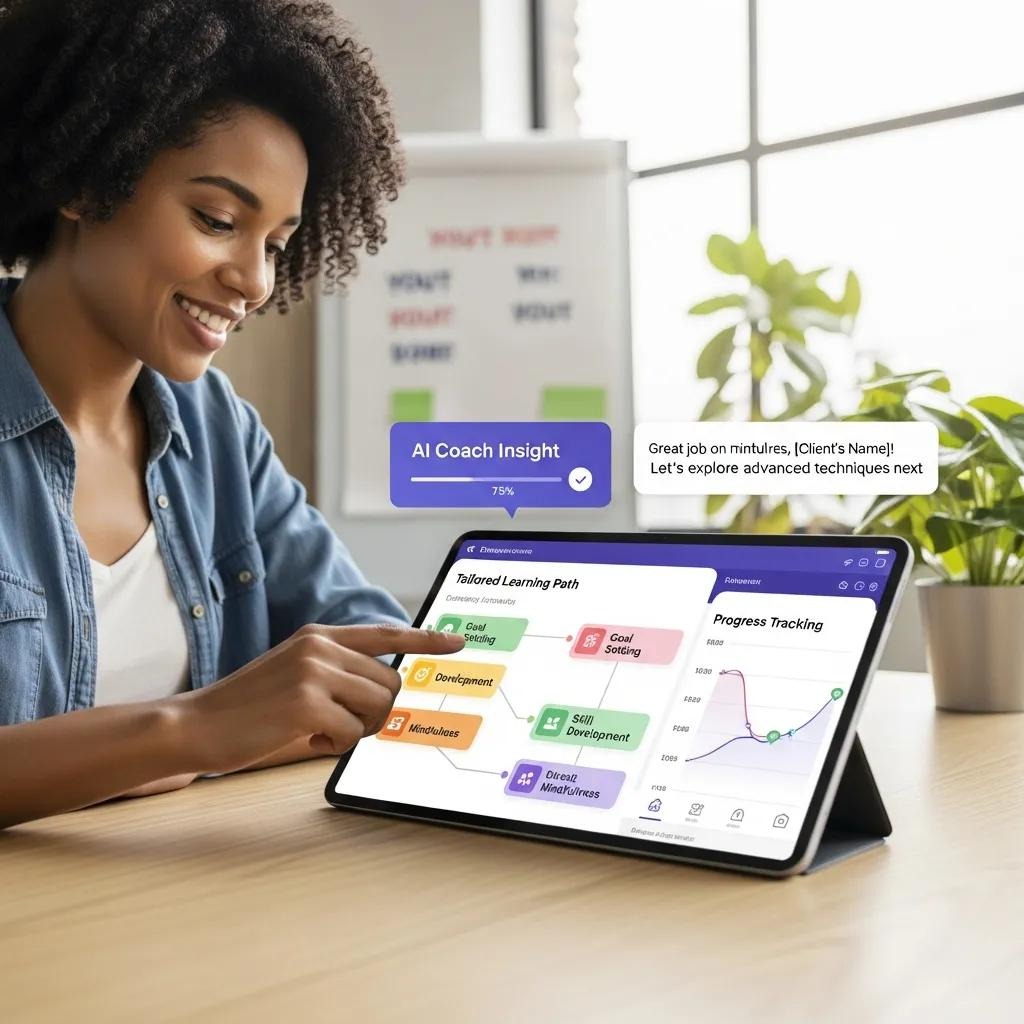
AI personalizes journeys by combining session transcripts, assessment scores, and behavioral signals to recommend next steps, tailor content, and send adaptive nudges that match each client’s pace. ML finds which interventions work for similar profiles and suggests sequences that improve goal attainment. NLP adds depth by detecting sentiment and conversational patterns, helping coaches tune tone and focus to a client’s emotional state. The net effect: better-timed, more relevant interventions that raise engagement and completion rates.
Examples: individualized learning modules when a knowledge gap appears, micro-habit nudges timed to reinforce session commitments, and adaptive pacing that expands or compresses learning paths based on demonstrated mastery. These ML-driven suggestions augment, not replace, human judgment and help set clearer expectations for measurable progress. Next, we look at the tools and platforms that deliver these capabilities.
How I Use AI Tools: I combine my own analysis with the AI’s analysis to see where the gaps are in learning. I can then either have the AI create a unique short video or send one we have in our database to fill in the gap for each client.
Which AI Tools and Platforms Empower Coaches Today?
The AI coaching ecosystem includes a few distinct tool categories: virtual coaching assistants, analytics and feedback systems, administrative automation, and content generation and assessment platforms. Choosing the right mix depends on privacy needs, integration points, usability, and the outcomes you want. Coaches evaluate vendors on how they store and process session data, model transparency, and how easily they can escalate to human oversight. Below is a concise list of categories to help teams decide where to start.
Common AI coaching tool categories:
- Virtual coaching assistants: 24/7 micro-coaching, reminders, and practice prompts to reinforce human sessions.
- Analytics & feedback platforms: Process transcripts and behavioral data to surface trends, sentiment shifts, and skill gaps.
- Administrative automation tools: Automate scheduling, billing, and documentation to reduce non-coaching work.
- Content generation & assessment tools: Create tailored learning content, role-play scenarios, and competency assessments.
When evaluating tools, prioritize data privacy, integration with existing systems, model explainability, and vendor reliability — these factors determine long-term adoption and impact.
Introductory comparison of representative tool types:
This table helps match functional needs to tool categories when planning pilots or procurement.
What Are Virtual Coaching Assistants and Chatbots?
Virtual coaching assistants are conversational agents powered by NLP that offer quick support, reminders, practice prompts, and resources between human sessions. They enable frequent micro-interactions that reinforce behavior change and keep momentum toward goals. Common flows include a brief check-in, a short exercise, and capturing client responses that feed analytics for coach review. While assistants increase contact frequency and reduce response time, they struggle with complex emotional nuance and high-stakes judgment — so reliable escalation paths to human coaches are essential.
Best practice: be transparent about the assistant’s role, get explicit consent for data use, and define clear handoff triggers when empathy or complex decision-making is needed. With human oversight, virtual assistants are effective adjuncts that preserve coach time while keeping clients supported between sessions.
How I Use AI Tools: I use a combination of chatbots on our site to answer questions for coaching clients and Voice AI in between sessions. This allows clients to get answers in real time.
How Do AI-Powered Analytics and Feedback Systems Work?
AI analytics systems ingest session transcripts, surveys, assessments, and behavioral signals, then apply NLP and predictive models to create dashboards, progress forecasts, and communication patterns. The pipeline begins with capture, moves to feature extraction (for example, sentiment, action items, and behavior frequency), and ends in visualizations and suggested interventions for coaches. These outputs turn qualitative conversations into structured signals that reveal trends a coach might miss in isolation.
Research is already exploring advanced architectures that improve interactive coaching through refined sentiment analysis and simulated learning.
AI Coaching Architectures for Interactive Sentiment Analysis
This paper proposes an automatic, interactive coaching architecture that combines an ML framework with a domain-trained dictionary system. The systems simulate human coaching interactions to evaluate outcomes and improve sentiment classification performance.
Improving sentiment classification performance through coaching architectures, A Fernández-Isabel, 2023
Coaches use analytics to prioritize interventions, measure impact, and adjust strategies. For example, a dashboard showing falling sentiment and recurring avoidance language can trigger targeted skill practice or escalation to human-led work. The value is in converting messy conversational data into clear, actionable signals.
How Does Human-AI Collaboration Improve Coaching Outcomes?
Human-AI collaboration — or hybrid coaching — assigns tasks so AI handles aggregation, routine communications, and personalized nudges while human coaches bring judgment, empathy, and complex problem-solving. AI provides scale and consistency; humans provide nuance and accountability. Hybrid models increase contact frequency, ensure consistent measurement, and let coaches focus on high-impact, human-dependent work. Seeing how this partnership plays out helps organizations design workflows that preserve coaching quality while benefiting from AI efficiencies.
Typical hybrid workflow: AI triages intake and gathers baseline data, surfaces recommended focus areas, schedules micro-interventions, and prepares structured summaries for the coach. The human then uses that input to do deeper, emotionally intelligent work and confirm or override AI suggestions. Clear governance and feedback loops let the system learn while keeping the human accountable.
- AI-first: Automated intake and triage route clients to human coaches when complexity exceeds thresholds.
- Coach-first: Coaches lead sessions and use AI analytics for sharper assessments and prep.
- Blended: Scheduled human sessions combined with AI micro-coaching between meetings to reinforce learning.
These templates help leaders choose a model that matches capacity and client complexity.
What Are Hybrid Coaching Models Combining AI and Human Expertise?
Hybrid models mix automation with human judgment using templates aligned to client needs and organizational goals. An AI-first approach automates intake and routine follow-up, escalating complex cases to human coaches to preserve safety while increasing throughput. A coach-first approach keeps humans central and uses AI analytics to enrich prep and synthesis, improving precision without removing agency. The blended model schedules regular human touchpoints while AI provides high-frequency micro-coaching and monitoring. Each model fits different maturity levels and resource constraints; pick based on case complexity and the level of empathy required.
Decision factors include client risk profile, regulatory needs, coach bandwidth, and desired scaling speed. Mapping those to a model helps preserve coaching integrity while gaining AI advantages.
What Best Practices Guide Effective AI Integration for Coaches?
Start with a focused pilot that defines success metrics, involves coaches early, and prioritizes privacy and explainability. Train coaches to read AI outputs and keep human-in-the-loop checks to avoid overreliance. Governance should cover consent management, data minimization, regular bias audits, and an update process that incorporates coach feedback. Finally, roll out iteratively with measurement cycles tracking engagement, goal attainment, and coach satisfaction.
Practical checklist for integration:
- Run a pilot with clear KPIs and a limited scope.
- Train coaches on analytics interpretation and escalation protocols.
- Publish transparent data policies and consent workflows.
- Schedule regular reviews and bias audits for models.
Following these steps helps AI amplify coach impact while maintaining ethics and measurable improvement.
What Ethical Considerations and Future Trends Shape AI in Coaching?
Ethics in AI coaching centers on data privacy, algorithmic fairness, transparency, and human accountability. Platforms and coaches must secure informed consent, limit retention, anonymize where feasible, and offer explainable recommendations. Algorithmic bias can skew assessments and guidance, so representative training data and routine audits are essential. Looking ahead, generative AI and affective computing will add capabilities and risks; practitioners should pair innovation with strong governance to sustain trust and effectiveness.
AI brings clear advantages — but those benefits come with ethical responsibilities, especially around data security.
Ethical Risks and Data Security in AI Coaching
While AI coaching offers many benefits, it also raises significant ethical concerns, including data security and privacy.
Ethics in digital and AI coaching, SJ Diller, 2024
This ethical framework supports responsible adoption and prepares organizations for near-term technological shifts that affect coaching practice.
How Are Data Privacy and Algorithmic Bias Addressed in AI Coaching?
Address privacy and bias through operational controls: explicit consent flows, encryption and anonymization, retention limits, and regular algorithmic audits to detect disparate impacts. Use explainability tools that translate model decisions into human-readable rationales so coaches can interpret and contest recommendations. Bias mitigation also requires representative training datasets and counterfactual analyses to uncover unintended correlations. Pair technical safeguards with governance processes so AI advice stays accountable and sensitive coaching data is protected.
Document data flows and set review cycles that include coaches, legal, and ethics stakeholders to keep practices aligned and corrective actions timely.
What Emerging AI Technologies Will Impact Coaching Effectiveness?
Near-term technologies poised to shape coaching include generative AI for simulated role-plays and content creation, affective computing that infers emotion from multimodal signals, and multimodal models that combine speech, text, and behavioral data for richer assessments. Generative AI can create realistic practice scenarios and personalized scripts to accelerate skill building, while affective models can surface engagement and emotional readiness for timely human intervention. Over a five-year horizon, these tools will increase personalization and fidelity — but they’ll also demand stronger validation, bias controls, and transparent consent models.
Thoughtful adoption will let coaches deliver more immersive practice, better measure soft-skill growth, and tailor interventions with greater precision.
How Is AI Applied in Specific Coaching Niches?
AI maps to coaching niches by matching tool capabilities with domain goals: executive coaching uses analytics for leadership behavior and 360 synthesis; employee development focuses on knowledge-gap detection and personalized learning journeys; life coaching relies on habit tracking and nudges to drive behavior change. Each niche benefits from targeted modules — for example, sentiment analysis for leadership feedback or progress dashboards for employee development — that link to measurable outcomes. Knowing these niche fits helps practitioners deploy AI where it delivers the most ROI and client impact.
Reference table: niche applications and outcomes.
How Does AI Enhance Executive and Leadership Coaching?
In executive coaching, AI strengthens assessment and development by analyzing communication patterns, synthesizing 360-degree feedback, and offering simulated leadership practice via generative scenarios. NLP surfaces language that signals delegation style, assertiveness, or avoidance, and analytics track change over time to demonstrate progress. Generative role-play provides safe rehearsal for difficult conversations with automated feedback, building confidence and transferable skills. These capabilities turn qualitative leadership behaviors into structured baselines and targeted development activities you can measure through promotions, performance reviews, and 360 scores.
AI-driven virtual coaches are already reshaping leadership development, delivering highly personalized practice at scale.
AI-Powered Virtual Coaches for Personalized Leadership Development
Bringing AI into leadership development unlocks deeper personalization through adaptive platforms and AI-powered virtual coaches.
Generative AI integration in leadership practice: Foundations, challenges, and opportunities, K Bottomley, 2025
By converting qualitative behavior into clear metrics, AI helps coaches and leaders prioritize development with clearer expected outcomes.
What Role Does AI Play in Employee Development and Life Coaching?
For employee development, AI spots skill gaps via assessment analytics and recommends tailored learning paths that align with role competencies, speeding upskilling and internal mobility. Predictive models forecast future skill needs and surface microlearning modules to close gaps efficiently. In life coaching, habit trackers and personalized nudges keep clients moving between sessions and increase follow-through. Key KPIs to monitor include engagement, goal completion, and client satisfaction — all of which improve when AI supports consistent practice and relevant interventions.
These examples show how AI-driven personalization converts into tangible improvements across professional development and personal behavior change.
Choosing the Right AI Coaching Platform for Organizations
As AI adoption in coaching accelerates, organizations increasingly look beyond individual tools toward an integrated AI coaching platform that supports both human expertise and scalable technology. The most effective platforms function as more than isolated features — they operate as full coaching software ecosystems that unify analytics, personalization, automation, and governance.
For larger organizations, enterprise coaching requirements often include secure data handling, configurable workflows, and integration with HR and learning systems. In these environments, an AI coaching platform must support consistency across cohorts while still allowing coaches to apply judgment, empathy, and contextual nuance. This is especially important when deploying a leadership coaching platform designed to support executives, managers, and high-potential leaders at scale.
From an HR and L&D perspective, modern coaching software increasingly overlaps with the capabilities of an employee performance platform. By combining goal tracking, behavioral analytics, learning pathways, and feedback loops, AI-enabled systems help organizations connect coaching activity directly to measurable outcomes such as engagement, readiness, and performance improvement. When coaching data feeds into broader talent and performance conversations, leaders gain clearer visibility into development progress and return on investment.
Before committing to a solution, organizations should evaluate whether the platform supports human-in-the-loop workflows, offers transparent AI explainability, and aligns with ethical and privacy standards. Most vendors allow stakeholders to request a demo to explore how AI-driven insights, virtual coaching assistants, and analytics dashboards work in real scenarios. Taking this step helps teams assess fit, usability, and impact before scaling across the organization.
Selecting the right AI coaching platform is not just a technology decision — it’s a strategic choice that shapes how coaching supports leadership development, employee performance, and long-term organizational growth.
If you’re ready to implement AI responsibly, increase productivity, and scale without burning out your people or your margins, the next step is to register for our next Launch Button AI challenge by Clicking Here or https://yourailaunch.com/